
Introduction
[Text]
[Text]
[Text]

In our daily lives, we find numerous vibrating phenomena, such as the sound produced by the strings of a guitar or violin when played, or the vibration of the vocal cords when speaking. These phenomena are characterized by repetitive oscillatory movements around a center of equilibrium, remaining in the vibrating object.
Waves are disturbances that propagate through a medium, and can be mechanical, acoustic, electromagnetic, seismic, among others. They are fundamental because they transmit energy, like light waves that travel in a vacuum until they reach our planet, giving it light and heat.
The study of waves and vibrations is crucial to understanding various natural phenomena, such as sound, by studying their properties, such as frequency, amplitude, period and speed of propagation in different media.
Therefore, in this topic we will delve into the properties of vibrations and waves, exploring their characteristics, how they are generated, how they propagate and how they affect our environment.
Explanation
2.1 Simple harmonic motion
We will start with the simplest type of oscillation, the one that repeats over time. This type of vibration or oscillation is called periodic motion. An example of this movement is a child swinging on a swing.
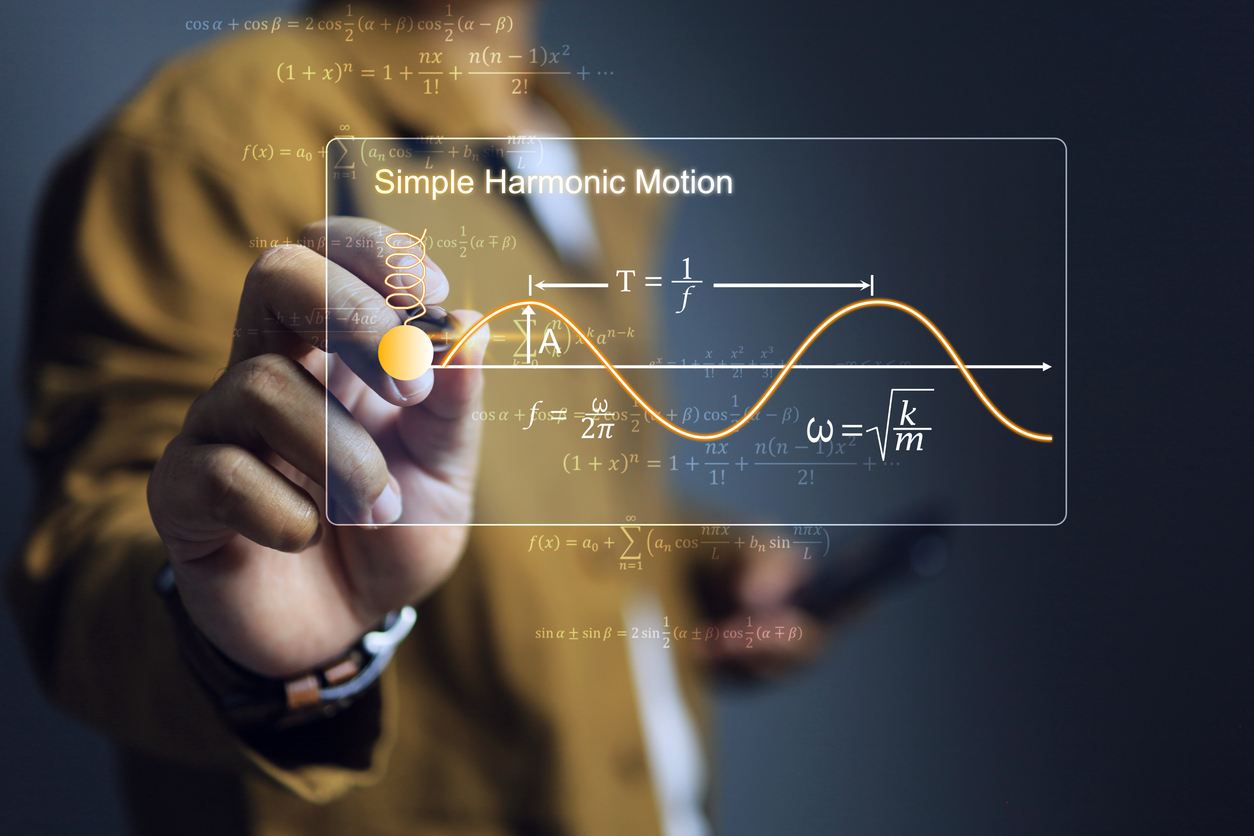
The idealized periodic movement (does not change over time) is called simple harmonic motion (SHM), and it has the following properties (Serway and Jewett, 2018):
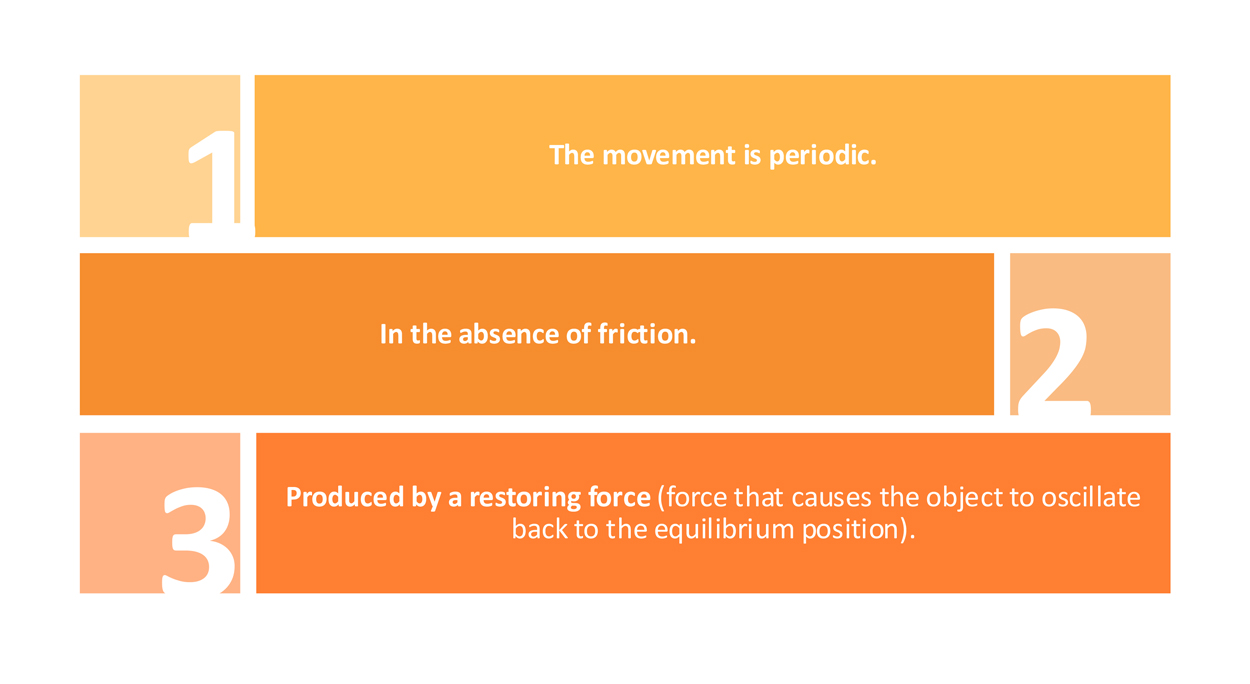
In the SHM, an object oscillates around a balanced position. Once the oscillator moves away from this position, it will reach a maximum distance to both sides. If we apply this concept to the child on a swing, we assume that there is no resistance that stops movement, so the child will swing around the equilibrium position. This equilibrium position is in the center and will reach the same height at both ends at each swing. Some examples of SHM are springs, pendulums and circular motion.
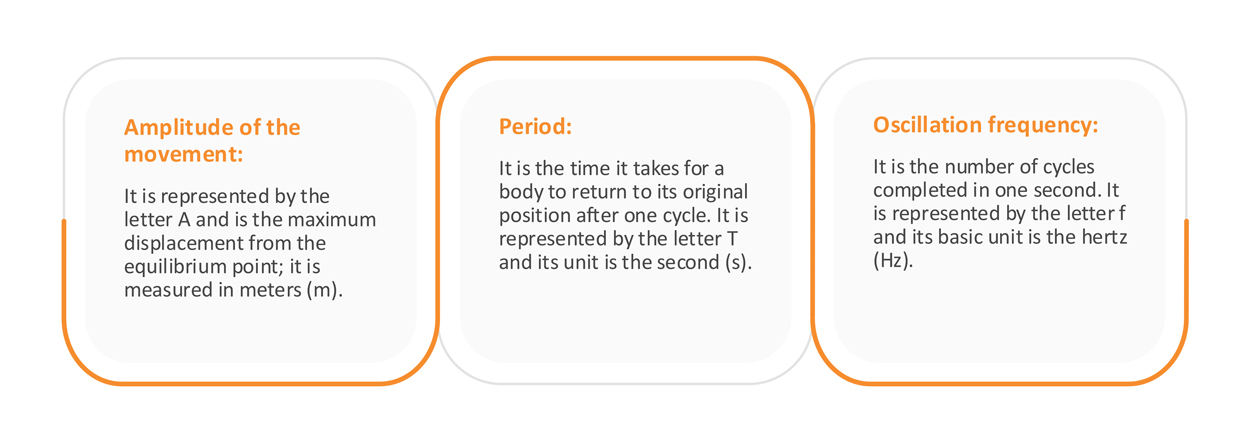
Before we begin the study of simple harmonic motion, we need to know some properties of oscillation.
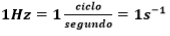
A hertz has the following equivalence:
 (Eq.
2.1)
(Eq.
2.1)
The mathematical relationship between frequency and period is as follows:
 (Ec.
2.2)
(Ec.
2.2)
 (Ec.
2.3)
(Ec.
2.3)
Angular offset : is the number of oscillations expressed in radians and is represented by the Greek letter theta θ.
1 Revolution = 360° = 2π radians (Eq. 2.4)
Angular displacement or number of cycles (measured in radians) per second. It is represented by the Greek letter omega ω and its unit is rad/s.
The mathematical relationship between angular frequency ω and frequency f is as follows:
 (Ec.
2.5)
(Ec.
2.5)
The relationship between angular displacement θ and angular frequency ω is as follows:
 (Eq.
2.6)
(Eq.
2.6)
Table 2.1 shows the properties described above.
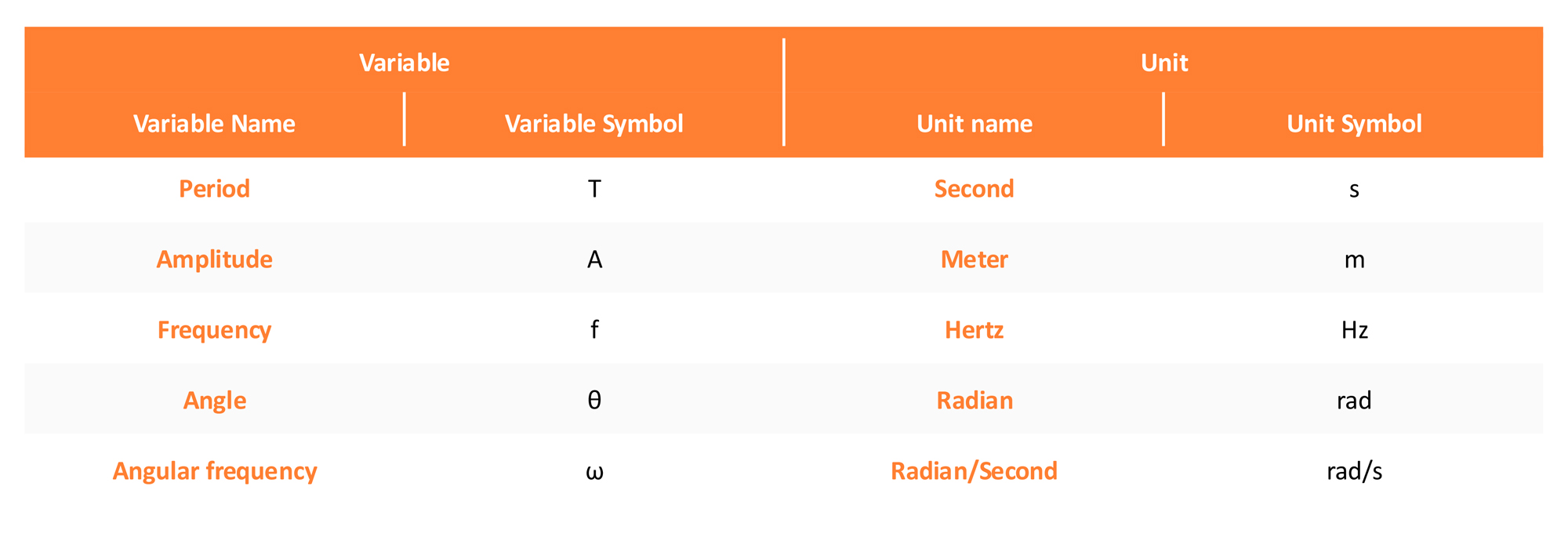
Table 2.1 Variables and units.
Example 1
A DJ is using a turntable to mix music at a party. If the platter rotates at 33 rpm. Calculate:
- The frequency of rotation in rev/s.
- The period in seconds.
- The angular velocity in rad/s.
Solution:
- We convert rev/min to rev/s:
Since 1 min = 60 s, we multiply by the factor \(\frac{1\ \min}{60\ s}\):
\[f\, = \,\frac{33\, rev}{\min} \bullet \frac{1\, min}{60\, s} = 0.55\,\frac{rev}{s}\]
- To determine the period, we used Ec. 2.3:
\[Τ = \frac{1}{f} = \frac{1}{0.55} = 1.81\, s\]
- To determine the angular speed we use Ec. 2.5
\[\omega = 2\pi f = 2\pi\left( 0.55\,\frac{rev}{s} \right) = 3.45\,\frac{rad}{s}\]
Simple Harmonic Motion and Hooke’s Law
To start the study of simple harmonic motion, we will start with the analysis of movement in a spring with a mass tied at one end. If we stretch the spring, a reinstatement force will return it to equilibrium. Due to the inertia of the movement, the spring will compress and the restoring force will return it to the equilibrium point. In the absence of friction, the spring will continue to oscillate with an amplitude of equal magnitude on both sides (see figure 2.1).
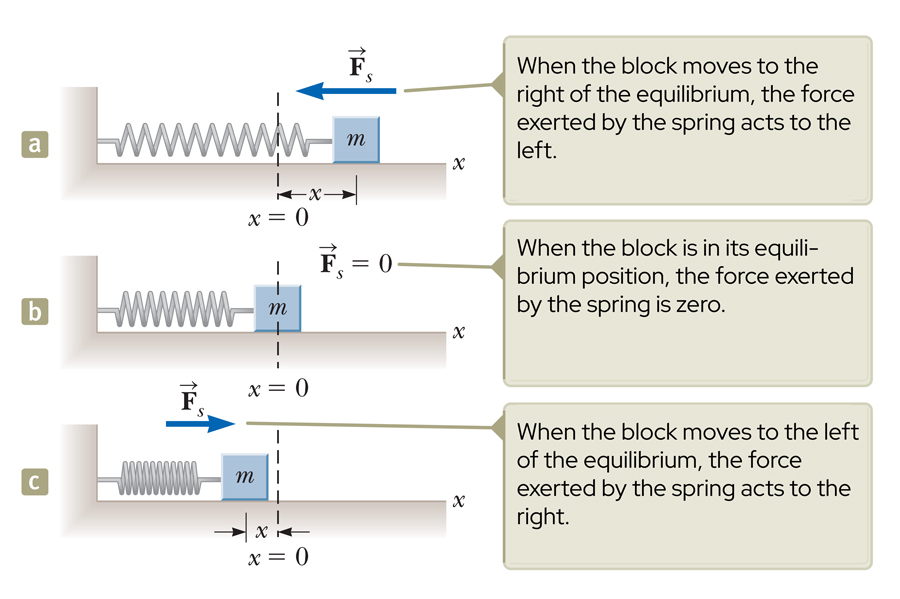
Figure 2.1 The block oscillates back and forth when disturbed from its equilibrium position.
Source: Serway, R., & Jewett, J. (2018). Física para ciencias e ingeniería. Mexico: Cengage Learning.
In a spring, the force of restitution obeys Hooke's law:
 (Ec.
2.7)
(Ec.
2.7)
Where:
F = Force applied (N)
k = Spring constant (N/m)
x = Displacement from equilibrium point (m)
Hooke's law uses a negative symbol for force. This is because a positive displacement (to the right) will produce a negative force in the opposite direction of the displacement (to the left). Similarly, a negative shift (to the left) will produce a positive force in the opposite direction (to the right).
To better understand Hooke's Law, watch the following video:

Yo Amo la Física. (2024, September 9). La Ley de Hooke [Shorts]. Retrieved from https://youtube.com/shorts/NINtrzegEO4?si=VPayweAj_v1rXIt0
This link is external to Universidad Tecmilenio, by accessing it please note that you must adhere to its terms and conditions.
SHM and Newton’s second law
If we want to know the acceleration in which the mass in the spring oscillates, we can add the second Newton’s law (F=ma). Therefore, the formula for maximum acceleration will be as follows:
 (Eq.
2.8)
(Eq.
2.8)
According to Newton’s second law, acceleration is a=F/m. The term –kx is the restitution force and m the mass, so the division of them is the acceleration of the oscillator.
Single harmonic motion energy
A spring illustrates the example of potential energy. Each time we compress or stretch a spring and release it, the energy we use to compress or stretch it is transformed into kinetic energy (motion energy).
The potential energy (U) stored in a spring that has been stretched or compressed is calculated using the following equation:
 (2.9)
(2.9)
The unit for expressing potential energy is joule (J).
As at SHM we assume there is no friction in oscillation, then we have the following formula for energy conservation:
 (2.10)
Where:
x0 = Initial position (m)
v0 = Initial velocity (m/s)
xf = Final position (m)
vf = Initial velocity (m/s)
Equations of Motion
Simple harmonic motion vibrations can be studied as waves because there is amplitude, oscillation period, and frequency. To study it, it is compared to a sine wave (see figure 2.2).
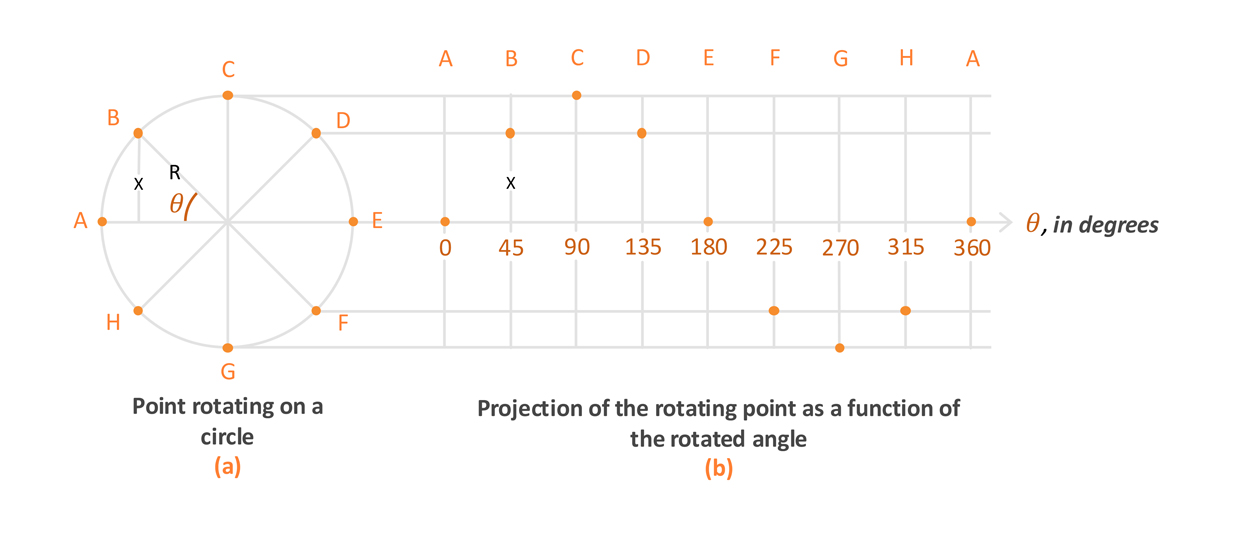
Figure 2.2 Simple harmonic motion.
Position as a function of time
If we relate the SHM to a sine wave, then the position (x) at any time can be found with the following equation:
 (Ec.
2.11)
(Ec.
2.11)
The position (x) will be given in meters and the time (t) in seconds. Please review Table 2.1 for any questions in symbology or units.
Speed as a function of time
When a reset force acts on the oscillator, the speed at the maximum point of travel (width) will be zero. Therefore, the maximum speed (vmax) will be at the steady state. So the equation for velocity as a function of time will be as follows:
 (Eq.
2.12)
(Eq.
2.12)
In terms of amplitude, the maximum speed for a spring can be calculated by:
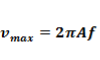 (Eq.
2.13)
(Eq.
2.13)

 (Eq.
2.14)
(Eq.
2.14)
Units for speed are m/s and for time are seconds. Please review Table 2.1 if you have any questions on symbology or units.
Accelerating as a function of time
The acceleration of the SHM at any time is given by:
 (Eq.
2.15)
(Eq.
2.15)
 (Eq.
2.16)
(Eq.
2.16)
The units for acceleration are m/s2. Review Table 2.1 for any questions on symbology or units.
Frequency and period in SHM
Now that we know more about the position (x), velocity (v) and acceleration of the SHM, we can express equations for the frequency (f ) and the period (T).
 (Eq.
2.17)
(Eq.
2.17)
The period is the inverse of the frequency, therefore:
 (Eq.
2.18)
(Eq.
2.18)
If we apply equations 2.15 and 2.16 to the spring, the corresponding equations will be as follows:
 (Eq.
2.19)
(Eq.
2.19)
 (Eq.
2.20)
(Eq.
2.20)
Example 2
A 180 gram block is attached to a spring with a constant of 4 N/m, and can oscillate without friction as in Figure 2.1. The block moves away from the equilibrium position 3 cm and is released from rest. Determine:
- Period of oscillation
- The oscillation frequency.
- The angular speed.
- Amplitude.
- The displacement after 3 seconds.
- The maximum speed.
- The speed after 3 seconds.
- Acceleration after 3 seconds.
Solution:
- To determine the period, Eq. 2.20:
\[Τ = 2\pi\sqrt{- \frac{m}{k}} = 2\pi\sqrt{- \frac{0.180\, kg}{- 4\,\frac{N}{m}}} = 1.33\, s\]
- With Eq. 2.2 we determine the frequency as the inverse of the period:
\[f = \frac{1}{Τ} = 0.75\,\frac{rev}{s}\]
- Angular speed is obtained with Eq. 2.5:
\[\omega = 2\pi f = 2\pi\left( 0.75\,\frac{rev}{s} \right) = 4.7140\,\frac{rad}{s}\]
- The amplitude corresponds to the maximum distance of the object from the equilibrium position, which would be 3 cm= A = 0.03m.
- The maximum speed can be calculated with Eq. 2.13:
\[v_{\max} = 2\pi Af = 2\pi(0.03\, m)\left( 0.75\,\frac{rev}{(s)} \right) = 0.1414\,\frac{m}{s}\]
- The displacement after 3 seconds is determined with Eq. 2.11 (remember that the calculator must be set in radians):
\[x = Acos\omega t = (0.03\, m)\left( \cos(4.7140 \bullet 3s) \right) = - 0.0001\, m\]
- The speed after 3 seconds is calculated with Eq. 2.12
\[v = - v_{\max}sen(\omega t) = - 0.1414\,\frac{m}{s} \bullet sen\left( 4.714\,\frac{rad}{s} \bullet 3s \right) = \, - 0.1414\,\frac{m}{s}\]
- The acceleration after 3 seconds is calculated with Eq. 2.16
\[a = - 4\pi^{2}f^{2}x = - 4\pi^{2}(0.75)^{2}( - 0.0001\, m) = 0.0022\,\frac{m}{s^{2}}\]
Single pendulum
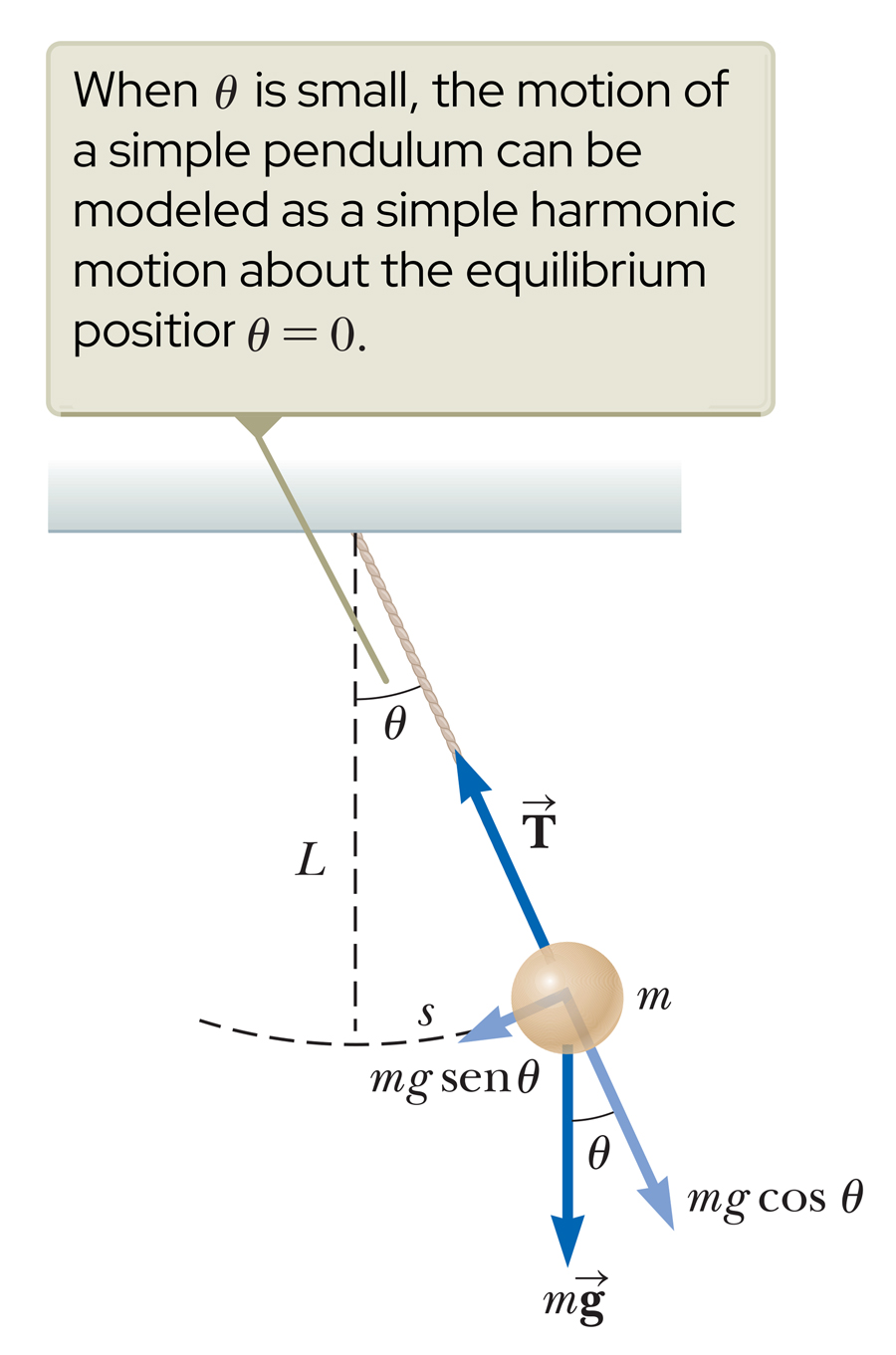
Figure 2.3 Simple pendulum.
Source: Serway, R., & Jewett, J. (2018). Física para ciencias
e ingeniería. Mexico: Cengage Learning.
The pendulum shown in Figure 2.3 consists of a string of length L and a body of mass m. The length of the arc x that runs through the body from its position between the center and one end is given by \(\mathbf{x = L\theta}\), so, substituting x in Hooke's law (Eq. 2.7), the force remains as \(\mathbf{F = - kL\theta}\).
The weight of the body W is given by Newton's second law: \(\mathbf{W = mg}\), where g is the constant, \(\mathbf{g = 9.81\ }\frac{\mathbf{m}}{\mathbf{s}^{\mathbf{2}}}\). The force that causes the body to move along the arc is therefore \(\mathbf{F = - mg}\mathbf{\sin}\mathbf{\theta}\) and since, if angle \(\mathbf{\theta}\) is small, then \(\mathbf{\sin}{\mathbf{\theta}\mathbf{=}\mathbf{\theta}}\), and the force remains as \(\mathbf{F = - mg\theta}\).
Combining the two previous expressions, we obtain \(\mathbf{F = - kL\theta = - mg\theta}\), that is \(\frac{\mathbf{g}}{\mathbf{L}}\mathbf{=}\frac{\mathbf{m}}{\mathbf{k}}\) ; substituting in \(\mathbf{f =}\frac{\mathbf{1}}{\mathbf{2\pi}}\sqrt{\frac{\mathbf{m}}{\mathbf{k}}}\) we obtain:
\(\mathbf{f =}\frac{\mathbf{1}}{\mathbf{2\pi}}\sqrt{\frac{\mathbf{g}}{\mathbf{L}}}\mathbf{= 0.4985}\sqrt{\frac{\mathbf{1}}{\mathbf{L}}}\mathbf{Hz}\) (Eq. 2.21)
\(\mathbf{T = 2\pi}\sqrt{\frac{\mathbf{L}}{\mathbf{g}}}\) (Eq. 2.22)
In a pendulum, its mass does not matter. The frequency and period of oscillation will depend solely on the gravitational acceleration and the length of the string.
Example 3
An architect is calibrating a pendulum clock for a historic building. The watch pendulum is 2 meters long, and to ensure the accuracy of the watch, the architect needs to calculate the frequency and period.
Solution:
- \(f = 0.4985\sqrt{\frac{1}{L}} = 0.4985\sqrt{\frac{1}{2}} = 0.3525\ Hz\)
- \(T = \frac{1}{f} = \frac{1}{0.3525} = 2.837\ s\)
2.2 Wave propagation
Before continuing, it is important to identify the parts of a wave (see Figure 2.4). Some of its most common features are the following:
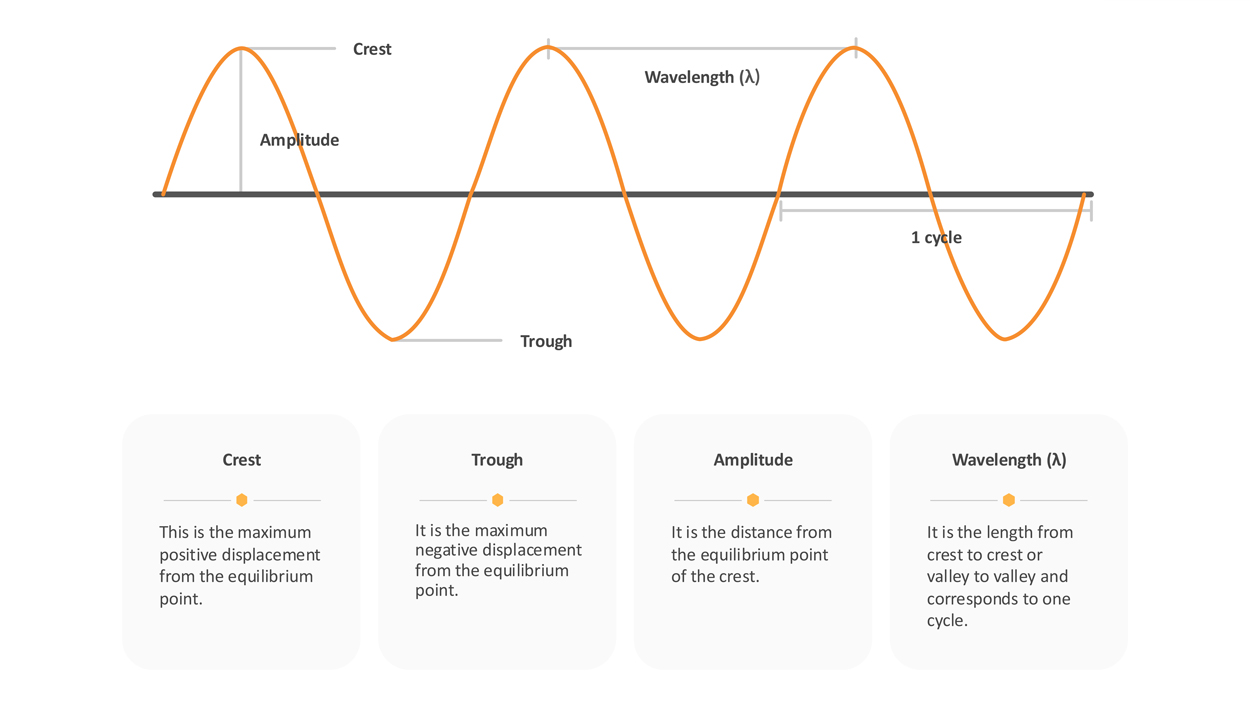
Figure 2.4 Anatomy of a wave.
Now that we have identified the parts of a wave we can see in detail its properties.
Mechanical waves
A mechanical wave is one that requires a means to spread. For example, sound needs air to travel, and sea waves need water to travel. There are two types of mechanical waves: transverse and longitudinal.
A transverse wave is when the particles of the medium vibrate perpendicular to the direction of movement of the wave. An example of this can be a Crossfit trainer exercising with ropes. This exercise involves lifting and lowering ropes with the movement of your arms. The ropes are anchored to a wall and with the movement form waves like those in figure 2.5, but that move towards the wall.
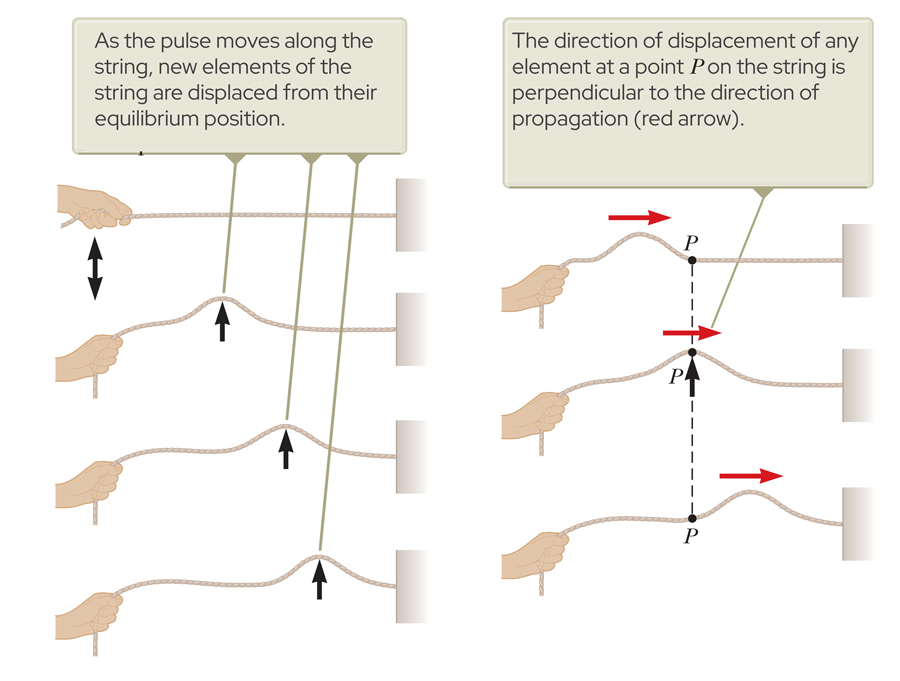
Figure 2.5 Transverse wave.
Source: Serway, R., & Jewett, J. (2018). Física para ciencias
e ingeniería. Mexico: Cengage Learning.
On the other hand, a longitudinal wave is when the particles of the medium vibrate in the same direction as the movement of the wave, as you can see in figure 2.6. An example of this type of wave is the compression of air generated by vocal cords when speaking. When we talk, the air in the lungs compresses and expands in different ways to create sound. Sound waves and particle vibrations travel in the same direction.
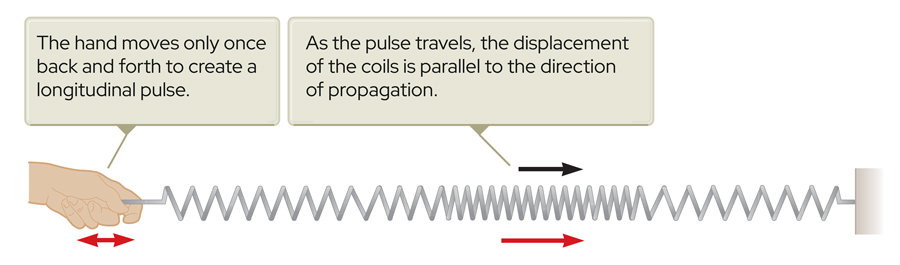
Figure 2.6 Longitudinal wave.
Source: Serway, R., & Jewett, J. (2018). Física para ciencias
e ingeniería. Mexico: Cengage Learning.
To observe the difference between a transverse wave and a longitudinal wave, watch the following video:
Hamza Ali. (2024, September 24). Transverse Vs Longitudinal Waves #SlinkySpring [Shorts]. Retrieved from https://youtube.com/shorts/15a2i3HgnPY?si=-ivMJhdUX91nb40f
This link is external to Universidad Tecmilenio, by accessing it please note that you must adhere to its terms and conditions.
You can see the comparison of the components of the two types of waves in Figure 2.7.
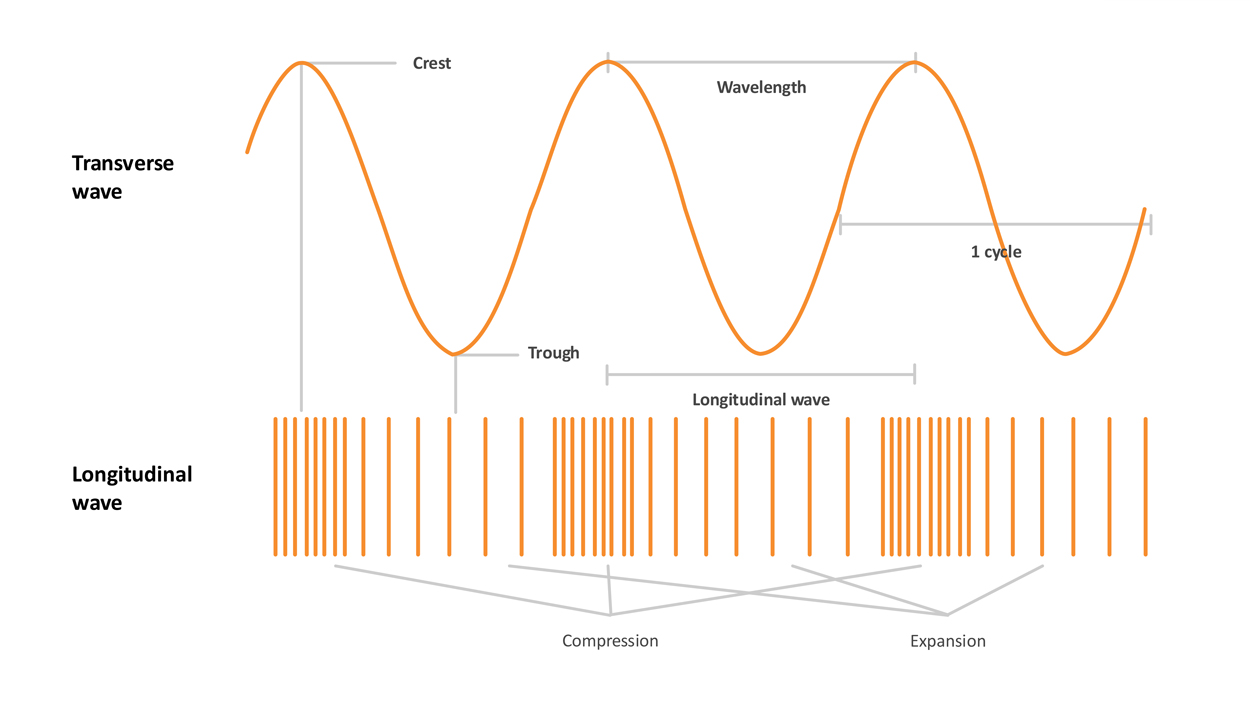
Figure 2.7 Transverse and longitudinal wave.
Single wave speed
The general formula for finding the velocity of a sine wave is as follows:
\(\mathbf{v = \lambda f}\) (Eq. 2.23)
Where:
v = Velocity (m/s).
λ = Wavelength (m).
f = Frequency (1/s or Hz).
We can calculate the wave speed by knowing your period (T):
\(\mathbf{v =}\frac{\mathbf{\lambda}}{\mathbf{T}}\) (Eq. 2.24)
We won’t always know the frequency or wavelength. When we don’t have that data, it’s important to consider the medium in which the wave moves, as the rate of propagation depends on the type of medium. If its propagation medium is a rope, then we must divide the tensile force acting on the rope (FT) and its linear density (mass per unit length).
Linear density can be calculated using the following formula:
\(\mathbf{\mu =}\frac{\mathbf{m}}{\mathbf{L}}\) (Eq. 2.25)
Where m is the string mass (kg) and L is the length of the rope (m).
Therefore, the rate of propagation of the wave in a rope is calculated using the formula:
\(\mathbf{v =}\sqrt{\frac{\mathbf{F}_{\mathbf{T}}}{\mathbf{\mu}}}\) (Eq. 2.26)
Where FT is the tensile force (N) and μ the linear density (kg/m). The units of velocity are m/s.
For example, a guitar string is tuned by changing the tension of the string. When you change the string tension you change its propagation speed and vibration frequency. The tuning of the guitar depends on its vibration frequency.

If you look closely at the strings of a guitar, you will notice that the strings are of different thickness and material. The mass distribution in the strings (or linear density) will cause different frequencies and therefore different sounds.
Example 4
An engineer is designing a cable system for a hanging bridge. One of the cables has a length of 4 meters and a mass of 100 kg. The cable is subjected to a tension of 17000 N. At what speed does a wave propagate along the cable? If the cable completes 3 vibration cycles in 2 seconds, what is the wavelength of the cable vibration?
Solution:
First we calculate the linear density of the chord with Eq. 2.25:
\[\mu = \frac{m}{L} = \frac{100\, kg}{4\, m} = 25\,\frac{kg}{m}\]
Then we calculate the velocity with Eq. 2.26:
\[v = \sqrt{\frac{F_{T}}{\mu}} = \sqrt{\frac{17000\, N}{25\,\frac{kg}{m}}} = \, 26\,\frac{m}{s}\]
If we know the rope completes 3 cycles in 2 seconds, then:
\[f = \frac{3\ ciclos}{2\ s} = 1.5\ Hz\]
We can now use equation 2.24 and clear \(\lambda\ \) to determine the vibration wavelength in the cable.
\[v = \lambda f\ \]
\[\lambda = \frac{v}{f} = \frac{26\,\frac{m}{s}}{1.5\, Hz} = 17.3\, m\]
Energy of a wave
One of the most important characteristics of waves is that they carry energy. As the waves travel, the vibrating particles transfer energy between the medium. The mathematical formula for calculating the energy carried by a mechanical wave (called intensity I) is:
 (Eq.
2.27)
(Eq.
2.27)
Where:
I = Wave intensity (Watt/m2).
v = Propagation velocity (m/s).
ρ = Medium density (kg/m3).
f = Frequency (Hz).
A = Amplitude (m).
Earthquakes and their relationship to waves
When a disturbance occurs due to the movement of the earth's tectonic plates, it produces a wave propagation through the earth's cap, which in various places on the planet has different intensity.
So far we have seen waves that are kept oscillating at the same amplitude and frequency. In nature, mechanical waves have cushioning, causing waves to dissipate as they progress. This is how seismic waves lose energy as they travel over the surface, so the intensity of an earthquake is greater at its epicenter.
Seismic waves can be of various types, as seen in Figure 2.8:
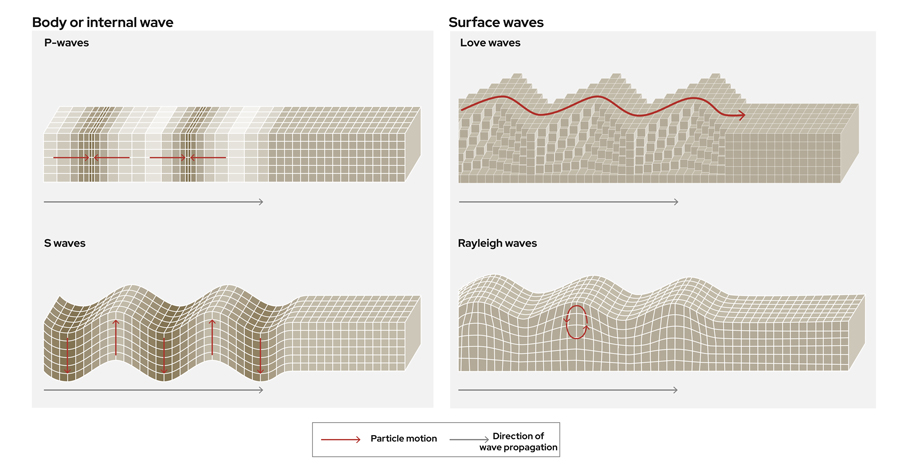
Figure 2.8 Seismic Wave Types.
Source: Instituto Geográfico Nacional de la República Argentina.
(n.d.). Ondas Sísmicas. Retrieved from
https://static.ign.gob.ar/anida/02AFN/sismologia/e_afn_sis_ondas_sismicas_300.jpg
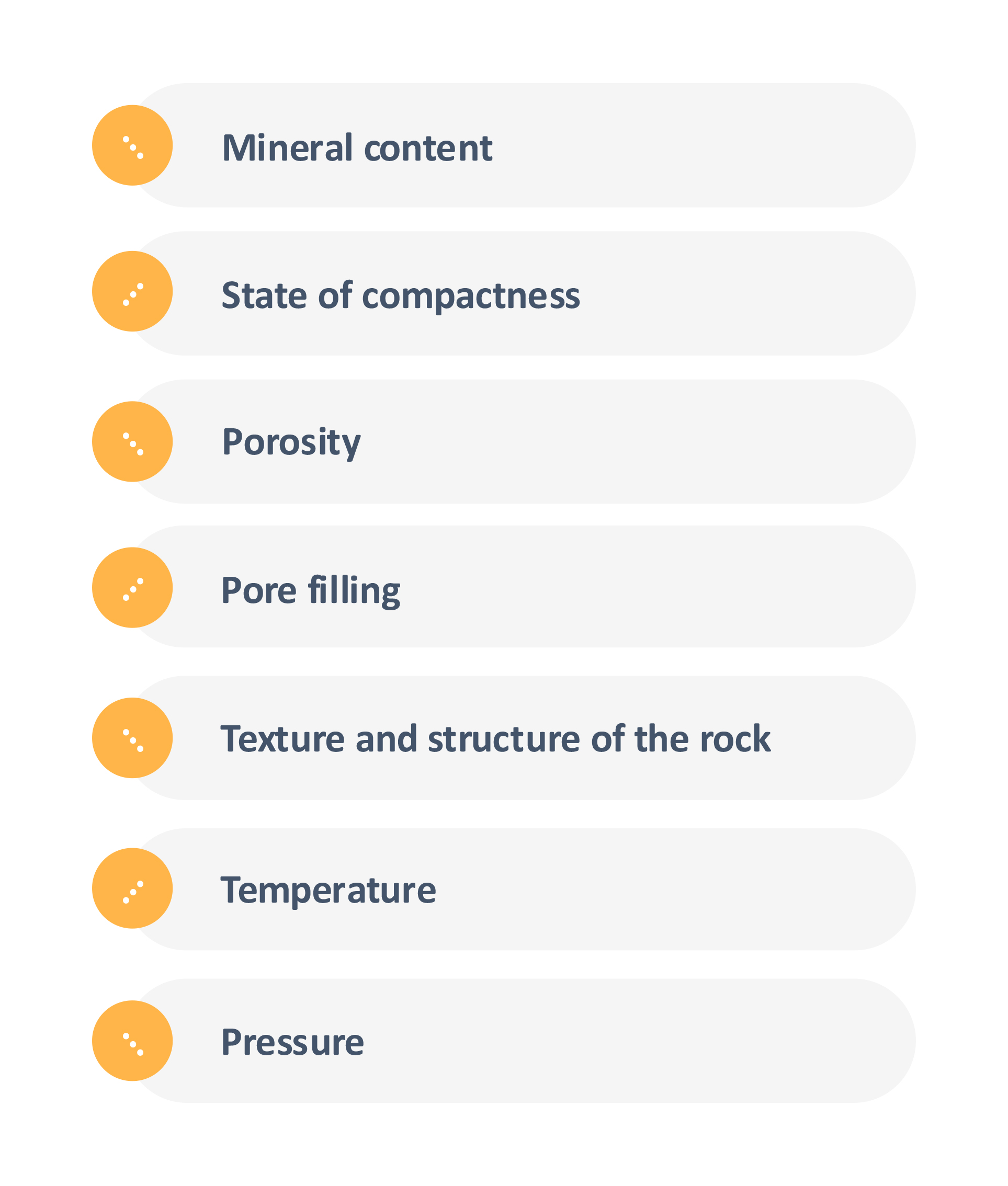
According to Griem (2020), the speed of propagation of the "p" and "s" waves depends on the properties of the rocks, such as:
To better understand the differences between seismic waves, watch the following video:
TEDI LatAm. (2023, May 9). ¿Ondas Sísmicas? #ondassísmicas #ingenieriacivil #sismologia #construcción #evaluacionderiesgos [Shorts]. Retrieved from https://youtube.com/shorts/-YbOKE1PBuE?si=sFlKDvb2O25Di4AS
This link is external to Universidad Tecmilenio, by accessing it please note that you must adhere to its terms and conditions.
2.3 Sound waves
Sound waves are mechanical waves that, although they can travel in any material, are more common for them to spread through the air, making them noticeable to humans. They are longitudinal waves, because their molecules vibrate in the same direction of their propagation. In other words, a sound source emits a collection of compressions and expansions of the medium that move in the same direction as that of the wave (see figure 2.9).
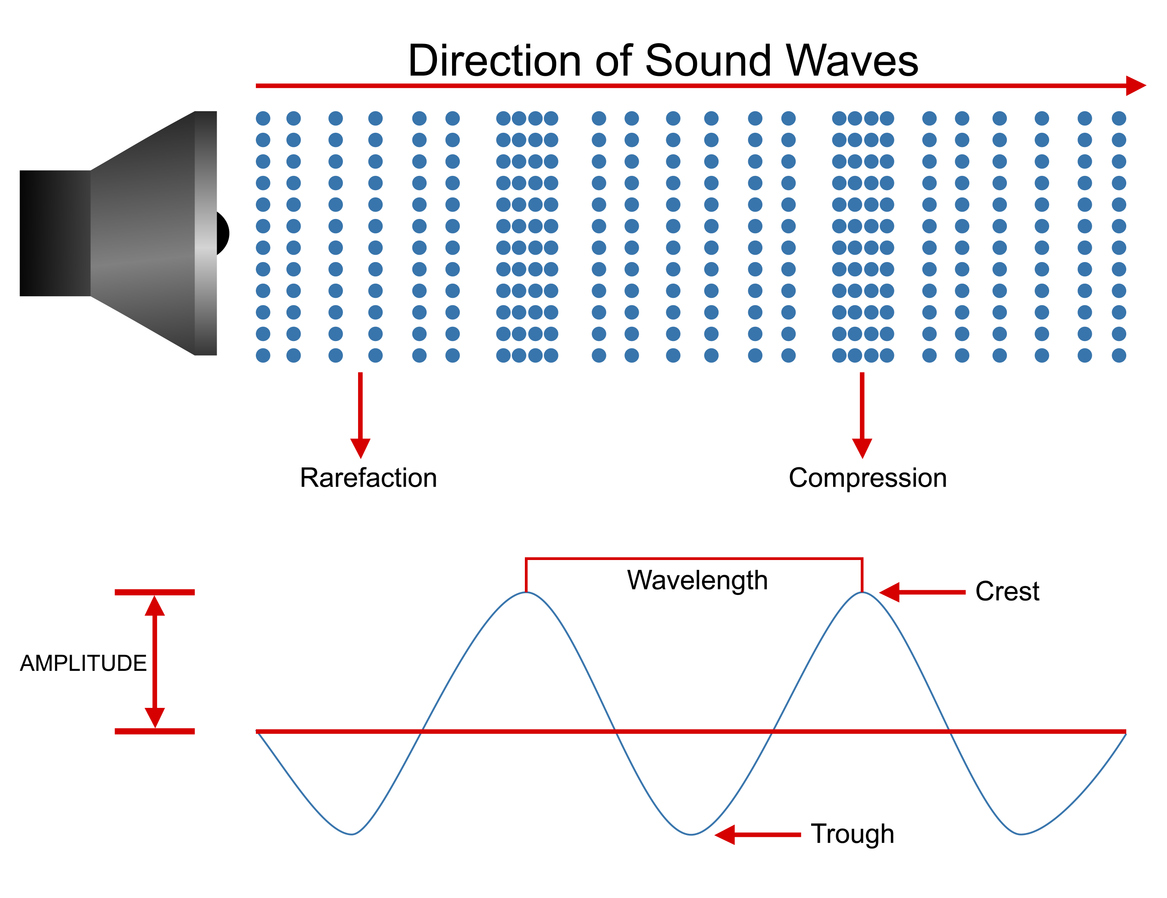
Figure 2.9 Sound wave.
We learned that to calculate the velocity of a transverse wave we need to know the force of restitution (FT) and an inertial factor (μ). Similarly, to know the speed of a longitudinal wave we need to know the force of restitution and the inertial factor. The rate of propagation of the wave will vary depending on the medium in which you travel. For example, the wave velocity in air at room temperature is 343 m/s, but for any other medium at that temperature the velocity will be different.
The formulas for calculating the propagation of sound on different media are as follows:
Sound speed in a fluid
When sound is transmitted in a fluid it is important to take into account the difficulty in compressing the fluid (volume module) and the fluid inertia (density). The formula for calculating the speed is as follows:
 (Eq.
2.28)
(Eq.
2.28)
Where:
B = Volume module (Pa).
ρ = Fluid density (kg/m3).
Speed on a metal rod
When waves propagate on a metal rod, the elasticity of the material (Young's modulus) and the density of the metal are taken into account. The formula for calculating the rate of propagation is as follows:
 (Eq
2.29)
(Eq
2.29)
Where:
Y = Young's Modulus (Pa).
ρ = Metal density (kg/m3).
Speed of sound in a gas
When sound spreads in a gas, we need to take into account the adiabatic constant (Y) and gas pressure (P), these act as the force of return. The density of the gas (ρ) is the inertial factor. The formula for calculating the propagation of sound in a gas is as follows:
 (Eq.
2.30)
(Eq.
2.30)
We can also use the following formula to calculate the velocity of propagation in an ideal gas:
 (Eq.
2.31)
(Eq.
2.31)
Where:
Y = Adiabatic constant (1.4).
R = Universal gas constant (\(8.314\ \frac{J}{mol \bullet kg}\)).
T = Gas temperature in kelvin.
M = Molecular mass of the gas (mol).
Sound speed on extended solid
To calculate the rate of sound propagation in an extended solid we can use the following formula:
 (Eq.
2.32)
(Eq.
2.32)
Where:
B = Volume modulus (Pa).
S= Shear modulus (Pa)
ρ = Density of the material (kg/m3).
Example 5
In the telecommunications industry, copper cables are essential for signal transmission. Determine the speed of sound in a copper wire with a Young's modulus of 110x109 Pa and a density of 8960 kg/m3.
Solution:
To know the speed of sound in a metal rod, Equation 2.29 is used:
\[v = \sqrt{\frac{\Upsilon}{\rho}} = \sqrt{\frac{110 \times 10^{9}\, Pa}{8960\,\frac{kg}{m^{3}}}} = 3504\,\frac{m}{s}\]
Sound intensity

Depending on the properties of the sound wave, such as frequency and intensity, it is the type of sound we will hear. The frequencies of sound that the human ear can hear range from 20 Hz to 20 KHz. Frequencies less than 20 Hz are called infrasonic waves, and those greater than 20 KHz are called ultrasonic waves.
Sound intensity is another important property because it is what we know as volume. The louder the sound, the greater the intensity of the wave; so you can consider it as a measure of the energy with which sound spreads.
The formula for calculating sound intensity is as follows:
 (Eq.
2.33)
(Eq.
2.33)
Where:
I = Sound intensity (W/m2).
P = Power (W).
A = Wave area (m2).
The minimum intensity for a human being to hear, corresponding to 1000 Hz, is as follows:

The maximum intensity for human hearing is as follows:

Above this intensity, the wave will cause ear pain.
2.4 The Doppler effect
A very interesting sound-related phenomenon is the Doppler effect. This effect explains why, when hearing an ambulance approaching, the sound is perceived more acutely, while when it moves away, the sound becomes more severe.
Serway and Jewett (2018) define the Doppler effect as “the change in frequency heard by an observer whenever there is relative movement between a source of sound waves and an observer”. In other words, it is the change in frequency of a moving sound source relative to a listener.
Figure 2.10 shows this effect. If you were standing in front of the police vehicle, the waves coming from the siren would gather as the car moves forward. As the waves approach, the frequency of the sound increases and causes a high-pitched sound to be heard. Once the vehicle is in front of you, the waves are heard at its emission frequency.
As the waves move further and further apart this will result in a lower frequency and therefore a low sound.
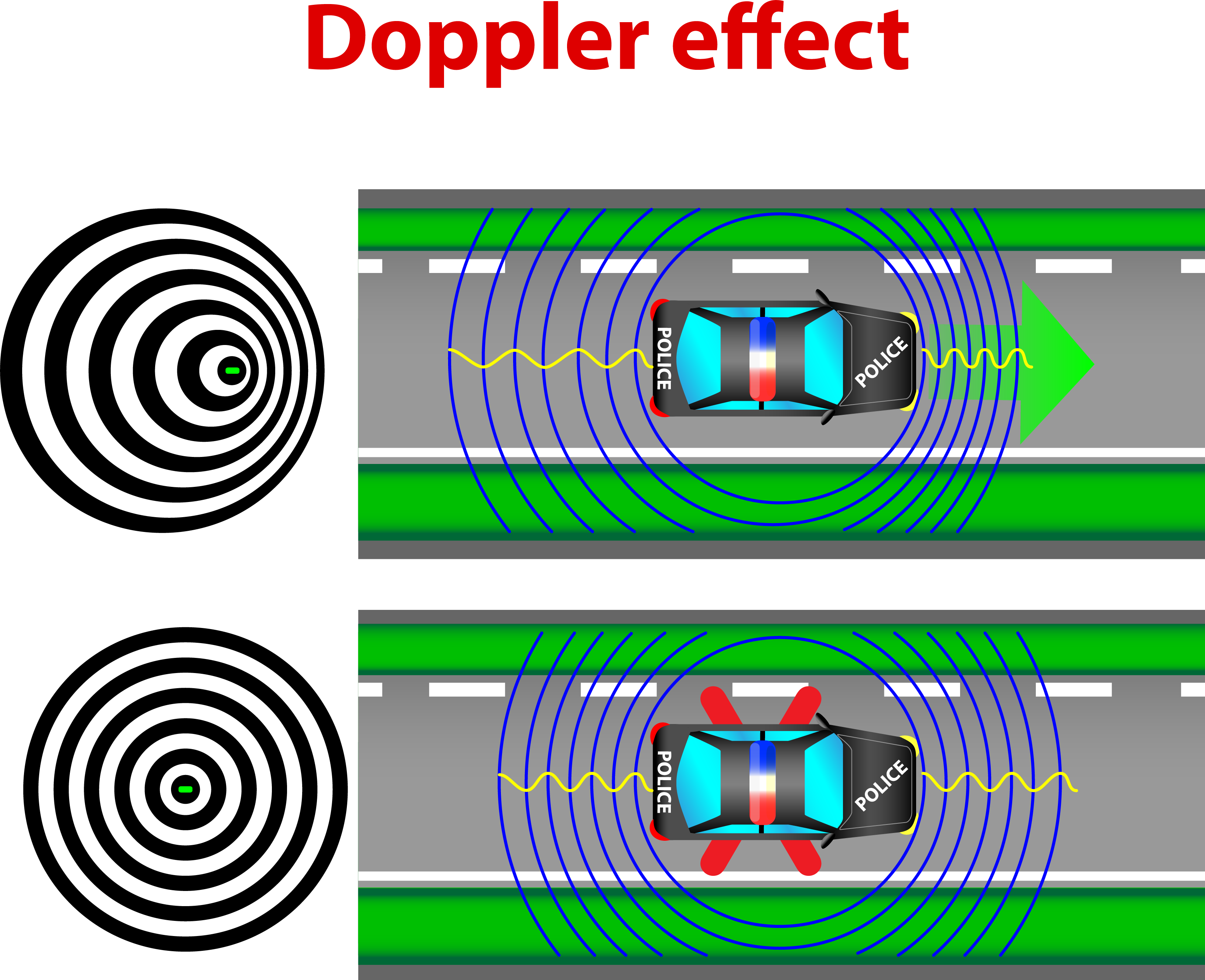
Figure 2.10 Doppler effect.
To calculate the frequency at which a sound is heard, we need to consider whether the emitter, listener or both are moving.
- Moving Emitter
To calculate the frequency a listener hears when the emitter is in motion, we need to use the following equation:
 (Eq. 2.34)
Where:
fL = Listener listening frequency (Hz).
V = Speed of propagation of sound (343m/s in air at room temperature).
vE = Emitter speed (m/s).
fE = Frequency at which sound is emitted (Hz).
A positive (+) sign will be used when the sender moves away from the listener and a negative (-) sign will be used when the sender approaches the listener.
- Moving listener
If the listener is the one moving toward the sound emitter or away, then the mathematical formula for calculating the frequency he hears is as follows:
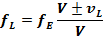 (Eq.
2.35)
(Eq.
2.35)
Where:
fL = Frequency heard by the listener (Hz).
V = Speed of propagation of sound (343m/s in air at room temperature).
vL = Listener speed (m/s).
fE = Frequency at which sound is emitted (Hz).
The positive sign (+) is used when the listener approaches the sender and the negative sign (-) is used when the listener moves away from the sender.
- Moving listener and sender
If the sender and listener are on the move, the formula for calculating the frequency the listener hears is as follows:
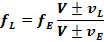 (Eq.
2.36)
(Eq.
2.36)
Where:
fL = Frequency heard by the listener (Hz).
V = Speed of sound propagation (343m/s in ambient air).
vL = Listener speed (m/s).
vE = Emitter speed (m/s).
fE = Frequency at which the sound is emitted (Hz).
The positive sign (+) is used when the listener approaches the emitter and the negative sign (-) is used when the listener moves away from the emitter (numerator).
A positive (+) sign will be used when the emitter moves away from the listener and a negative (-) sign will be used when the emitter approaches the listener (denominator).
Example 6
An ambulance traveling at 30 m/s approaches a pedestrian at a constant speed and then moves away from him. The ambulance siren emits sound waves with a frequency of 700 Hz. What will be the frequency of the sound the pedestrian hears when the ambulance approaches him, and when he moves away from him?
Solution:
The emitter is the one that is moving, so we will use Eq. 2.34.
The data that the problem gives us are the following:
Emitter speed vE = 30 m/s
Emitter frequency fE = 700 Hz
Sound speed V = 343m/s
If the emitter approaches the listener, we use the subtraction sign.
\[f_{L} = \frac{Vf_{E}}{V \pm v_{E}} = \frac{343\,\frac{m}{s\,}(700\, Hz)}{343\,\frac{m}{s} - 30\,\frac{m}{s}} = 767\, Hz\]
In the problem, the frequency the listener hears is higher than the broadcast frequency. Therefore, you hear a high-pitched sound (767Hz>700Hz).
If the emitter moves away from the listener, we use the plus sign.
\[f_{L} = \frac{Vf_{E}}{V \pm v_{E}} = \frac{343\,\frac{m}{s\,}(700\, Hz)}{343\,\frac{m}{s} + 30\,\frac{m}{s}} = 644\, Hz\]
In this case, the frequency is less than the issue frequency. Therefore, you hear a low sound (644Hz<700Hz).

2.5 Stationary waves and resonance
Standing Waves
We’ve seen the parts of a wave, the types of mechanical waves, and their velocity of propagation. Now we’re going to focus on waves that don’t spread.
When a rope that is tensioned stretches in the center, the wave that is formed will travel to one end and return inverted to the opposite end. In such a way that two waves will be formed that travel in opposite directions.
When the two waves come together, destructive interference occurs and is called a node. Similarly, when the crest of one wave meets the valley of the other wave, constructive interference occurs and an antinode is created. Figure 2.11 shows the nodes and anti-nodes of a fixed string.
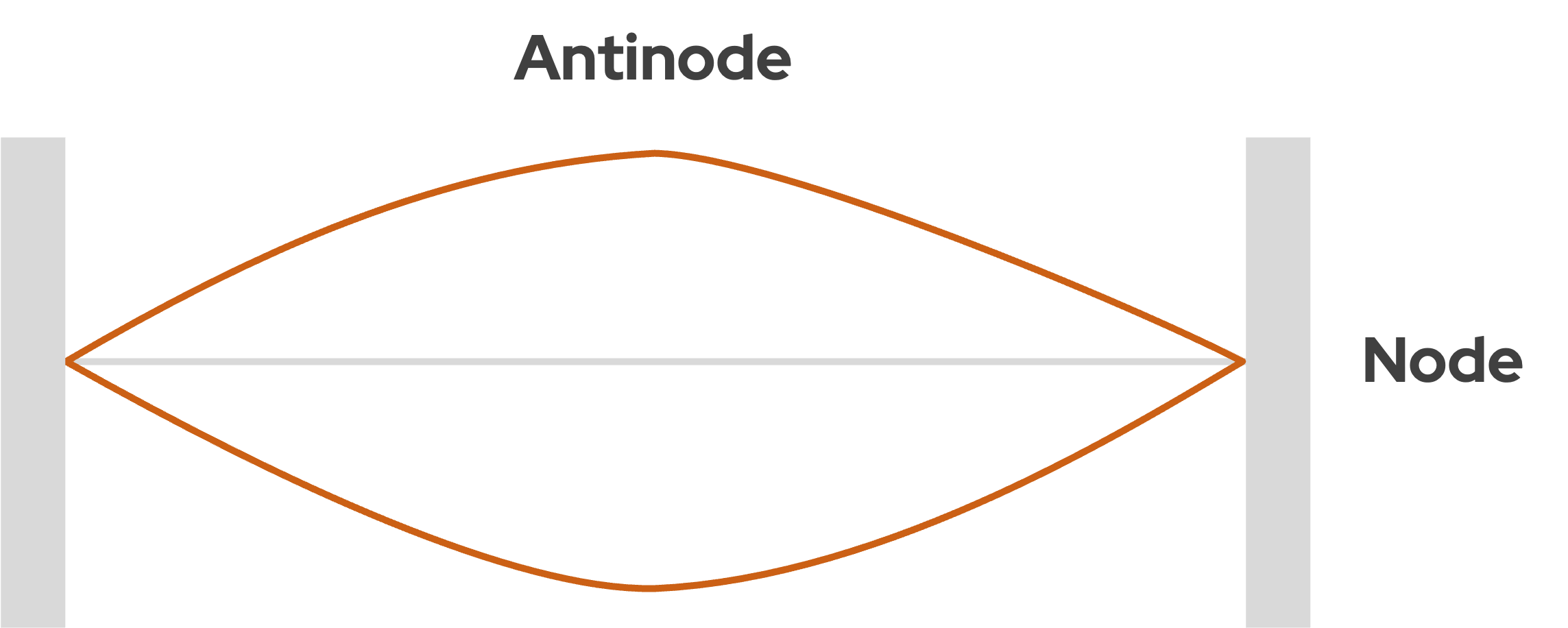
Figure 2.11 Node and Antinode.
If the oscillation frequency is higher, more nodes and antinodes will be created in the rope. Figure 2.12 shows the nodes and antinodes of a string vibrating at a higher frequency.
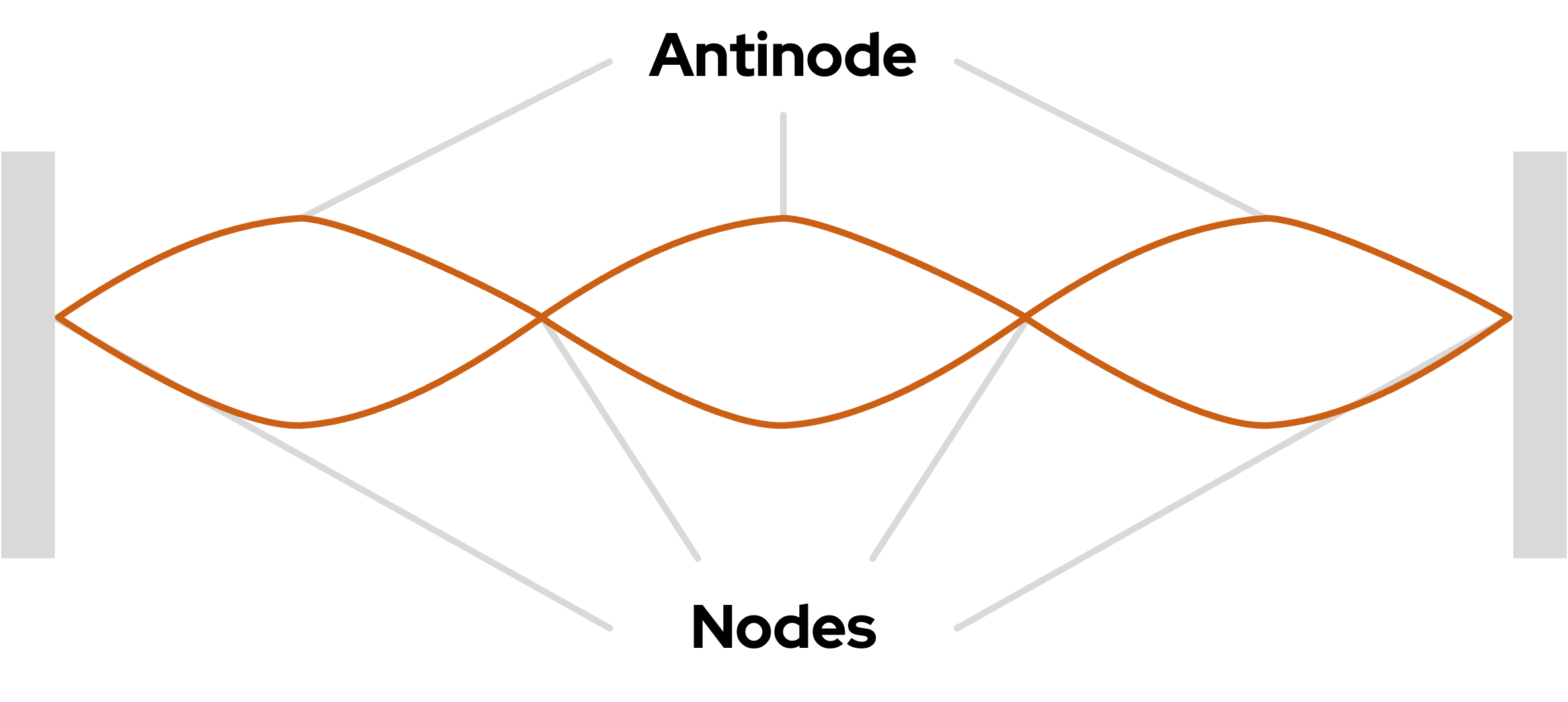
Figure 2.12 Nodes and anti-nodes at higher frequency.
Resonance
When different waves vibrating at different frequencies meet, a single vibration of greater amplitude and different frequency is created. The lowest resonance frequency is called the natural frequency and corresponds to a single antinode. If there is more than one antinode, the frequency of resonance will be higher.
Resonant frequencies are called harmonics. The first harmonic corresponds to the natural frequency, the second harmonic is when there are two antinodes, the third when there are three and so on (see figure 2.13).
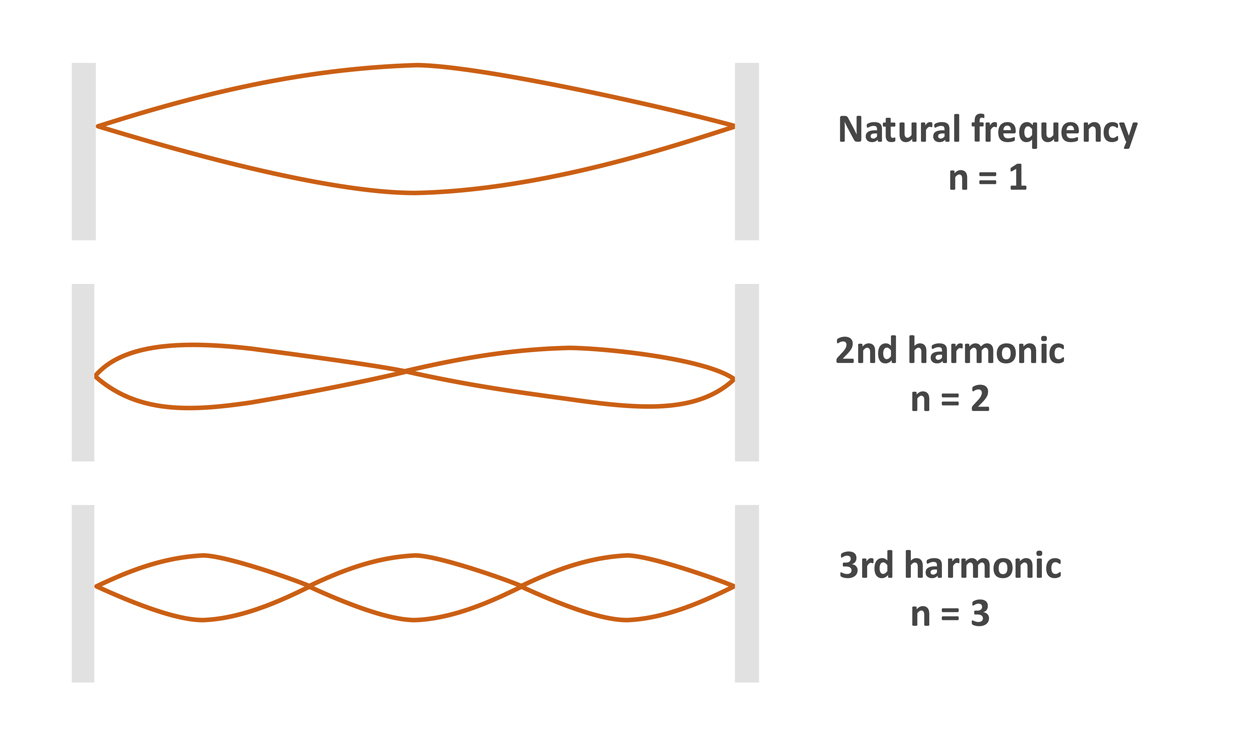
Figure 2.13 Resonance frequencies.
Resonance frequencies in a string
To find the resonance frequencies in a vibrating string we can start by defining that, if there is an antinode, only the wavelength λ corresponds to twice the length of the string (the length of the string is half a cycle).
As the frequency increases there will be more antinodes, therefore the wavelength will be shorter. Mathematically we can express it as follows:
 (Eq.
2.37)
(Eq.
2.37)
Using f =v/λ and equation 2.37, the formula for calculating resonance frequencies is as follows:
 (Eq.
2.38)
(Eq.
2.38)
If we express the propagation velocity as in equation 2.26, then:
 (Eq.
2.39)
(Eq.
2.39)
For formulas 2.37, 2.38 and 2.39, the natural frequency corresponds to n =1, the second harmonic n = 2, the third to n = 3 and so on.
Example 7
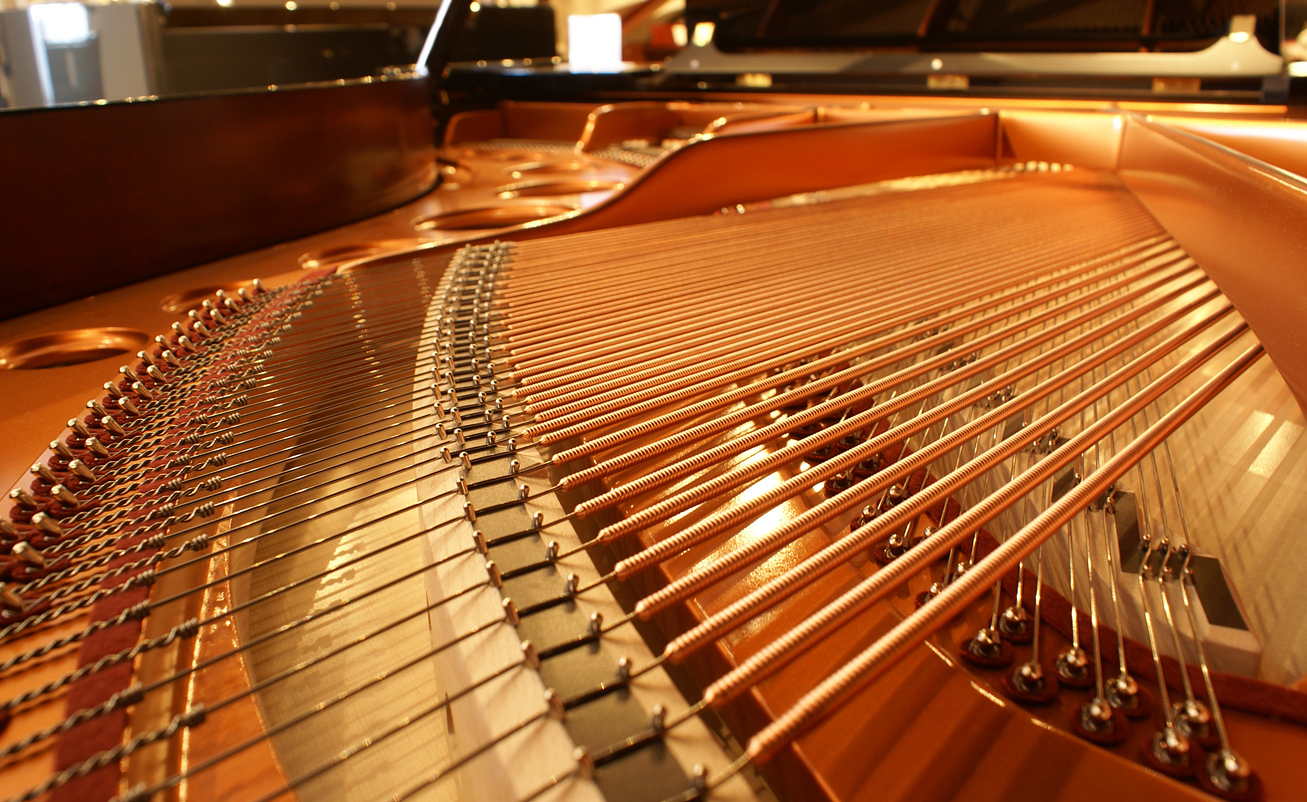
A string of a piano has a length of 0.9 m and a mass of 7.5 g, and is under a tension of 680N. Find: a) the frequency of the second harmonic, b) the propagation speed, c) the wavelength and d) the intensity of the wave if its amplitude is 1.8 mm.
Solution:
Data given by the problem:
String length L=0.9m
String mass m=7.5g=0.0075 kg
Tensile strength FT=680 N
To find the frequency, we first need to find the μ linear density of the string.

Then we use equation 2.39 to calculate the second harmonic (n=2).

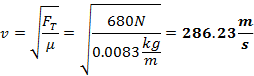
The velocity of propagation can be calculated using equation 2.26.
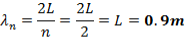
The wavelength can be calculated with equation 2.37.
Using the density of air at sea level ρ= 1,225 kg/m3, the intensity of the wave is as follows:

Standing waves in a cylinder
As you just studied, the resonant frequency depends on the mass of the string, its length, and the tensile strength.
We will now look at harmonics in a cylinder. Examples of this are musical instruments such as the trumpet, flute, organ, etc. In instruments, the frequency of the sound will depend on the internal dimensions of the cylinder, its length and whether it is open or closed.

An open tube is when the ends of the cylinder are open (as in a flute). When air passes through the tube, compressions and rarefactions of the air in the sound waves will form resonant frequencies (series of nodes and antinodes).
Possible wavelengths can be calculated by the following equation:
 (Eq.
2.40)
(Eq.
2.40)
Where:
n – Starts from n=1 (one node) and increases one by one (n= 1,2,3…).
L = Tube length (m).
As the velocity of a wave (v) is calculated by  , by clearing the frequency
(f ) and adding the equation 2.40. The formula for calculating
harmonics in an open tube is as follows:
, by clearing the frequency
(f ) and adding the equation 2.40. The formula for calculating
harmonics in an open tube is as follows:
 (Eq.
2.41)
(Eq.
2.41)
Values for n are n=1 (fundamental frequency) in one-by-one increments.
In a closed tube, the wavelengths and frequencies will differ from an open tube. There will be a node and an antinode at the beginning and end of the cylinder, this will cause the wavelength and frequency to use only odd numbers of n. The formula for calculating the length of a sound wave in a closed tube is as follows:
 (Eq.
2.42)
(Eq.
2.42)
Where n will be odd numbers (n = 1,3,5…) and L is the length of the tube.
As the wavelength formula changed for the closed tube, so will the formula for calculating resonance frequencies.
 (Eq.
2.43)
(Eq.
2.43)
Similarly n will be odd numbers only. Where n=1 represents the fundamental frequency, n=3 is the third harmonic, and so on.
Example 8
A musical instrument manufacturer is designing a flute and needs to calculate the fundamental frequency of a sound wave traveling in the flute tube. The flute is made to play in air at room temperature and has a length of 22 cm. The manufacturer wants to know the fundamental frequency, whether the flute has one end closed or both ends are open.
Solution:
In the previous section we saw that sound propagates in air at room temperature with a velocity of v = 343 m/s.
The length of the tube is L=22 cm or L=0.22 m.
- The fundamental frequency (n=1) in a closed tube is calculated with equation 2.41.
\[f_{1} = \frac{nv}{4L} = \frac{1\left( 343\,\frac{m}{s} \right)}{4(0.22m)} = 390\, Hz\]
- The fundamental frequency (n=1) in an open tube is calculated with equation 2.43.
\[f_{1} = \frac{nv}{2L} = \frac{1\left( 343\,\frac{m}{s} \right)}{2(0.22m)} = 780\, Hz\]
Conclusion

As you have discovered in this topic, the oscillatory and wave phenomena that we observe in the world, such as vocal cords, movements in a pendulum, sound waves and seismic waves, can be represented by mathematical models. These concepts are essential for sciences such as acoustics, optics, vibration mechanics, and other sciences at the microscopic level, such as quantum mechanics.
In addition, you explored the characteristics of mechanical waves and learned to calculate properties such as their frequency, propagation speed and the energy they carry, analyzing examples in everyday life such as sound and seismic waves. You also discussed the properties and characteristics of resting waves, resonance, and how to calculate resonance frequencies.
We hope that this knowledge will allow you to better understand how waves behave in different media and conditions, and how these principles are applied in engineering and science, contributing to the improvement of our daily lives.
Checkpoint
Make sure that you:
- Describe simple harmonic motion in physical systems such as pendulums and springs.
- Distinguish the different types of waves.
- Describe and analyze properties of waves.
- Determine the speed of propagation of waves in different media.
- Explain the Doppler effect and its application.
- Identify the characteristics of standing waves.
- Describe the resonance phenomenon.
References
- Griem, W. (2020). Métodos geofísicos - Sismología. Apuntes geología general. Retrieved from https://www.geovirtual2.cl/geologiageneral/ggcap01c.htm
- Serway, R., & Jewett, J. (2018). Física para ciencias e ingeniería. Mexico: Cengage Learning.
Tecmilenio has no affiliation with the brands mentioned as examples. The trademarks are the property of their respective owners in accordance with applicable law. They are used solely for academic and educational purposes, with no commercial intent, advertising relationship, or sponsorship involved.
Resources
The following links lead to external websites outside of Universidad Tecmilenio. By accessing them, please be aware that you must comply with their terms and conditions.
Readings
To learn more about the use of acoustic waves in medicine, we recommend reading:
- Veronese S, Ossanna R, Tehrani SG, Bernardi P, Khabouri S, Cannone V, Nicoletti MM, Goisis M, and Sbarbati A. (2025) The Impact of Acoustic Wave Therapy on Viability and Differentiation Capacity of Human Adipose Stem Cells. J Cosmet Dermatol 24(4). Retrieved from https://doi.org/10.1111/jocd.70142
To learn more about seismic waves, we recommend reading:
- Rüeg, P. (2025). Why seismic waves spontaneously race inside the earth. Retrieved from https://ethz.ch/en/news-and-events/eth-news/news/2025/06/why-seismic-waves-spontaneously-race-inside-the-earth.html
Videos
To learn about waves, watch the following video:
- Radience. (2025, July 24). What is a Wave? – Easy to Understand [Video File]. Retrieved from https://youtu.be/KPUkD4lLgY4?si=ar5GqlFpX7l4ty3L
To learn about the sound, watch the following video:
- Flipping Physics. (2019). What is Sound? [Video File]. Retrieved from https://youtu.be/IhzZAoSYDLE?si=ZuDLQ_VeQrM8ZvSd
To learn about resonance frequency, watch the following video:
- PranaWellnessHyd. (2025, February 11). Explained: Frequency vs. Resonance! [Video File]. Retrieved from https://youtube.com/shorts/NrXP3m2YqEY?si=WaZMZJCs3oQ36vzu
Tecmilenio has no affiliation with the brands mentioned as examples. The trademarks are the property of their respective owners in accordance with applicable law. They are used solely for academic and educational purposes, with no commercial intent, advertising relationship, or sponsorship involved.
The work presented is property of ENSEÑANZA E INVESTIGACIÓN SUPERIOR A.C. (UNIVERSIDAD TECMILENIO) and is protected under Mexico's Federal Copyright Law. Any alteration or modification of this work, as well as its reproduction, exhibition, or public presentation without the consent of the author and rights holder, constitutes a criminal offense under Mexico's Federal Copyright Law and International Copyright Laws. The use of images, video clips, extracts from cultural events, programs, and other materials subject to copyright protection is strictly for educational and informational purposes. Any other use, including commercial gain, reproduction, editing, or modification, is strictly prohibited and will be prosecuted by UNIVERSIDAD TECMILENIO. Copying, reproducing, distributing, publishing, transmitting, broadcasting, or otherwise exploiting any part of this work without prior written permission from UNIVERSIDAD TECMILENIO is prohibited. However, you may download material to your personal device for personal, educational, and non-commercial use only, limited to one copy per page. You may not remove or alter any copyright or proprietary notices on the copy.